Background: (Please read) http://www.warsoftheroses.com/origins.cfm
The Rulers: (Please read about each -- including 'split' rules -- and write a brief summary (a sentence or two) of each on your own blog) http://www.warsoftheroses.com/royalty.cfm
Part II: Richard III: Fact and Fiction
(respond in short answers of two or three sentences)
Please watch all four parts of the BBC animated Shakespeare's Richard III starting with part one: http://www.youtube.com/watch?v=hJXTreobkfc&feature=related then read the 'Controversy and Reputation' section on Richard III at Wikipedia for more background info. Answer the following: Why did Shakespeare portray Richard III the way he did?
Terminology: Answer the following: With regard to the history of Richard III, what is meant in distinction between "Traditionalist" or "Revisionist" source? What is meant between "Lancastrian" and "Ricardian"? (You may have to do some research to understand those terms.)
Read the following and explain whether each is "Lancastrian" or "Ricardian" -- be sure to quote directly from sections throughout your response:
from Vergil, Polydore. Anglica Historia, Books 23-25. London: J. B. Nichols, 1846.
And so yt was agreyd that Thomas archebisshop of Canterbury, Henry duke of Buchyngame, John lord Hward, and sundry other grave men should deale in that cause, who reparing unto the sayntuary began to perswade the quene with many fayre wordes and perswations that she wold returne with hir children into the palace, unto whom they gave both pryvate and publyke assurance; but the woman, forseing in a sort within hir self the thing that folowyd furthwith after, could not be movid with any perswations to commyt hir self to the credyt of duke Rycherd, which whan they understoode, fynally they demandyd to be delyveryd to them hir soon richard onely, which they obtaynyd hardly after many fayre promises. And so was thinnocent chyld pullyd owt of his mothers armes. Richard having by this meane obtaynyd almost his hartes desire, convaighed his nephewys from the bysshop of Londons howse unto the Towr; and yeat all this causyed no suspytion, for that thusage ys at the kings coronation for the whole assembly to coom out from thence solemly, and so procede to Westmynster. This doone, Richerd, whose mynde partly was enflamyd with desire of usurping the kyngdom, partly was trubblyd by guyltynes of intent to commyt so haynous wickednes (for a guiltie conscience causeth thoffendor to have dew punishment alway in imagination before his eyes), thowght aftireward nothing better than to mollyfy the multitude with largesse and lyberalytie, than to wyn the hartes of his adversaryes with gyftes, rewardes, and promyses, than in the Towr, wher himself and his nephews remayned, to consult, conferre, and delyberate of new with the noble men dayly in most craftie and subtyle maner for the dealing and disposing of suche thinges as wer furthwith to be doone. And this way his dryft, that, whyle stayng and tarying made the people desyrus of this solemne sight, he, by consultinge from poynt to poynt, might sound and serche out how the nobylytie was affected, saying alway that he did not seke the soveraigntie, but referryd all his dooings to the profyt of the realme. Thus covering and cloking certane days his desire, under the colour and pretence of common welthe, he so enveglyd the myndes of the nobilitye, that they all, few only exceptyd who wer not ignorant from the beginning what marke he shot at, dyd by no meane espy the cause of his lingering, or to what ende his practyses wold faule owt, so many matters dyd he so often propone and so few explane, according as a guyltie conscyence ys wont to be of many myndes. But in the mean time perceaving that William lord Hastings was most vehement and earnest to have prince Edward once crowned king, who chiefly amongst all the nobylytie was, for his bountifulnes and lyberalytie, much beloved of the common people, bearing great sway emong all sores of men and parsons of best reputation, whether yt wer that he fearyd his powr, or despearyd yt possible to draw him to his syde and opynyon, he determynyd to ryd the man owt of the way before his purpose showld be discoveryd to the resydew, whom he did not yeat fully trust. Wherfor, burning with rage incredible to bring to effect the thing which in mynd was resolvyd, he drew a plot for the lord Hastinges as foloweth: he placyd pryvyly in a chamber adjoyning to that with himself and other lords sat usually in cownsayll a sort right ready to do a mischiefe, geaving them in charge that when he showld geave a signe they showld suddaynly rushe owt, and, compassing about them who should syt with him, to lay handes specyally uppon William lord Hastinges, and kill him forthwith.
Horace Walpole (1768)
With regard to the person of Richard, it appears to have been as much misrepresented as his actions. Philip de Comines, who was very free spoken even on his own masters, and therefore not likely to spare a foreigner, mentions the beauty of Edward the Fourth; but says nothing of the deformity of Richard, though he saw them together. This is merely negative. The old countess of Desmond, who had danced with Richard, declared he was the handsomest man in the room except his brother Edward, and was very well made. But what shall we say to Dr. Shaw, who in his sermon appealed to the people, whether Richard was not the express image of his father's person, who was neither ugly nor deformed? Not all the protector's power could have kept the muscles of the mob in awe and prevented their laugh- ing at so ridiculous an apostrophe, had Richard been a little, crooked, withered, hump-back'd monster, as later historians would have us believe --- and very idly? Cannot a foul soul inhabit a fair body? The truth I take to have been this. Richard, who was slender and not tall, had one shoulder a little higher than the other: a defect, by the magnifying glasses of party, by distance of time, and by the amplification of tradition, easily swelled to shocking deformity; for falsehood itself generally pays so much respect to truth as to make it the basis of its superstructure. I have two reasons for believing Richard was not well made about the shoulders. Among the drawings which I purchased at Vertue's sale was one of Richard and his queen, of which nothing is expressed but the out-lines. There is no intimation from whence the drawing was taken; but by a collateral direction for the colour of the robe, if not copied from a picture, it certainly was from some painted window; where existing I do not pretend to say: in this whole work I have not gone beyond my vouchers. Richard's face is very comely, and corresponds singularly with the portrait of him in the preface to the Royal and Noble Authors. He has a sort of tippet of ermine doubled about his neck, which seems calculated to disguise some want of symmetry thereabouts. I have given two prints of this drawing, which is on large folio paper, that it may lead to a discovery of the original. My other authority is John Rous, the antiquary of Warwickshire, who saw Richard at Warwick in the interval of his two coronations, and who describes him thus: "Parvae staturae erat, curtam habens faciem, inaequales humeros, dexter superior, sinisterque inferior." What feature in this portrait gives any idea of a monster? Or who can believe that an eye-witness, and so minute a painter, would have mentioned nothing but the inequality of the shoulders, if Richard's form had been a compound of ugliness? Could a Yorkist have drawn a less disgusting representation? And yet Rous was a vehement Lancastrian; and the moment he ceased to have truth before his eyes, gave into all the virulence and forgeries of his party, telling us in another place, "that Richard remained two years in his mother's womb, and came forth at last with teeth, and hair on his shoulders."Further reading on Traditionalist vs Revisionist Histories of Richard III (not required, but interesting): http://www.r3.org/bookcase/more/index.html
Part Three: The Battle of Bosworth Field
Please read the following text and write two poems of your own in response, taking the point-of-view of Richard III in the first and Henry Tudor in the second. Each poem must be at least 250 words in length; style is completely your choice. Be sure to base your poem on primary historical sources and footnote each line or verse in your poem that corresponds to a source.
The Ballad of Bosworth Fielde Text from Bishop Percy's Folio Manuscript. Ballads and Romances, ed. J.W. Hales and F.J. Furnivall, 3 vols. (London, 1868), III, pp. 233-59. http://www.r3.org/bosworth/ballad2.html
Lots of primary sources on Lancastrians and Yorkists: http://www.fordham.edu/halsall/sbook1n.html#Later Medieval England
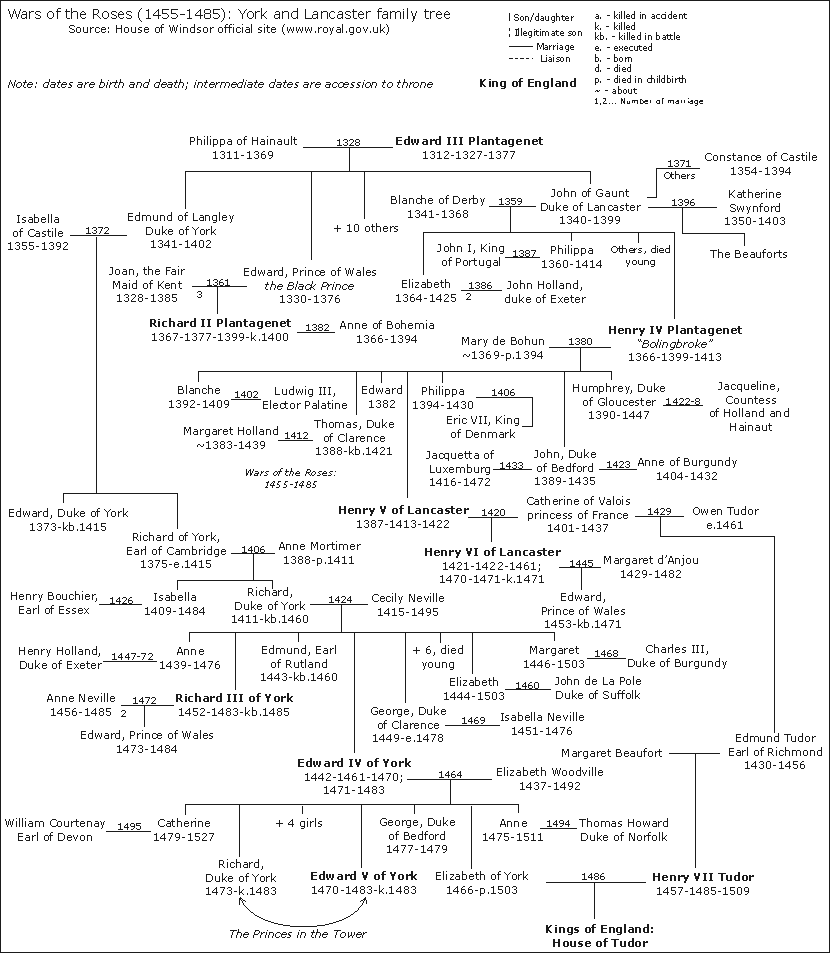
Here is a link to the English Monarchy family tree from Edward III to Henry VII: http://upload.wikimedia.org/wikipedia/commons/b/bc/WarRosesFamilyTree.png

No comments:
Post a Comment